A giant black hole will begin to absorb everything around it in 2.4 billion years: will this become a threat to Earth?
At the center of our galaxy is a supermassive black hole called Sagittarius A, which has a mass of 4.3 million suns and a diameter of about 24 million kilometers. It is currently in a quiet state, but scientists are sure that this will not be for long. This is reported by the Daily Mail.
Sagittarius A’s active phase will begin when it receives enough material for “food” – large volumes of gas and dust. Astronomers predict that this will happen in about 2.4 billion years, when the Milky Way collides with a dwarf galaxy – the Large Magellanic Cloud.
Black hole activity
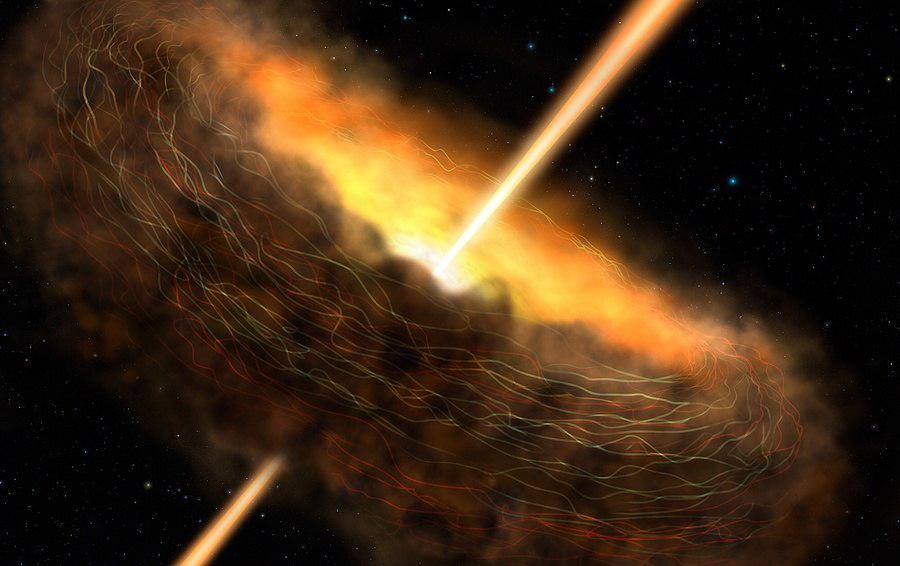
For their existence, black holes need matter, while the accretion disk that forms around them begins to rotate at high speeds, emitting massive energy flows. At certain moments, black holes can emit plasma jets that move almost at the speed of light.
The collapse of massive stars forms black holes, and supermassive black holes at the centers of galaxies are millions of times heavier than our Sun. Despite their enormous size, they are challenging to detect because their gravity is so strong that even light cannot escape the event horizon.
Potential threat to Earth
Even if Sagittarius A were to become active and begin to spew out energy in many billions of years, the risk to Earth would remain minimal. Our planet is located 26,000 light-years from the center of the galaxy, and dense clouds of gas and dust within the Milky Way would act as a natural shield, protecting us from radiation.
In the worst case, if the energy flows were robust and directed directly at us, we could expect damage to the ozone layer and potential mass extinctions. But the probability of this is extremely low, and the possible events would not occur until more than two billion years later.
Earlier, it was reported that discoveries could become a real revolution in the study of the boundaries of the Solar System, opening new horizons for astronomers. Additionally, scientists confirmed the reality of two miracles attributed to Jesus Christ and also discovered the birthplace of the apostles Peter, Andrew, and Philip.