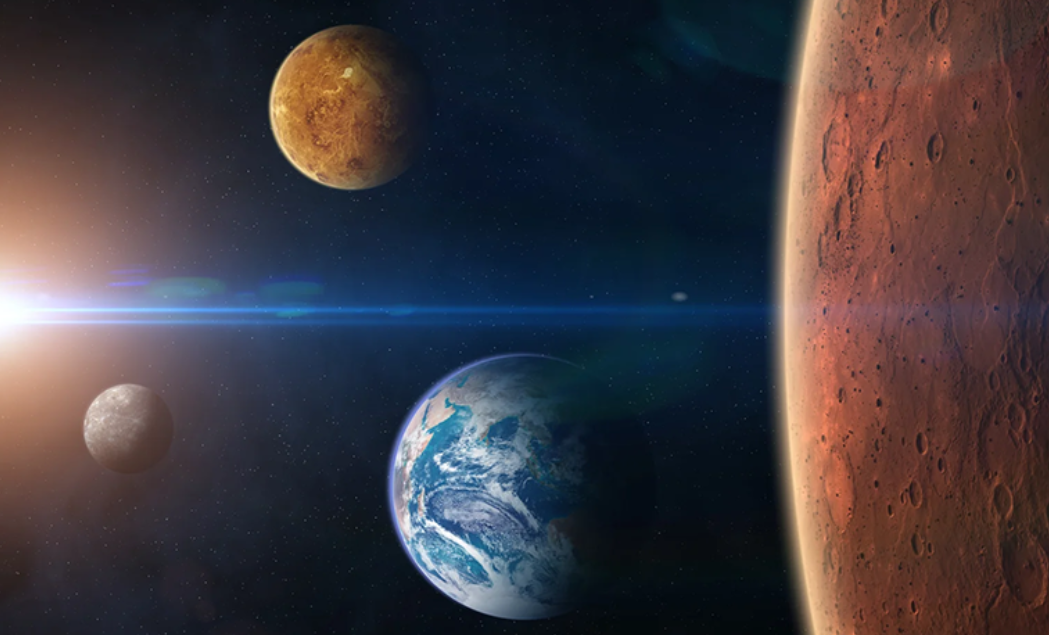
Astronomical sensation: on January 22, a rare phenomenon with three planets near the Sun will be visible in the sky
Such events do not happen every year, or even every ten years. In January, we will experience a phenomenon that astronomers consider unique to the 21st century.
On January 22, Venus, Mars, and Mercury will gather so close to each other and to the Sun that an almost perfect geometric shape will form in the sky. This “rhombus” of planets will be a rare cosmic observation.
On this day, the three planets will approach the Sun at an incredibly small angular distance – only three degrees. This is an extremely close distance on an astronomical scale. In the sky, they will appear neatly arranged in a small area, making this phenomenon even more unique. Such views require the coincidence of many factors: orbits, speeds, and viewing angles from Earth. The slightest shift can destroy this perfect symmetry.
Experts note that the chances of repeating such a cosmic rapprochement in the coming years are extremely small. The next time Venus, Mars, and Mercury will approach in this manner will be in September 2038, but not as compactly or precisely. This January cluster is an almost-perfect shot that appears only once every decade, or even once a century.
It is worth noting that preparations for this celestial show have already begun. Mercury is already available for observation through coronagraphs – specialized instruments that shade the solar disk and allow you to see objects nearby. However, Venus and Mars are still hidden in the glare of the Sun and will become visible a little later as they move away from it.
Scientists warn: this is a truly unique moment that should not be missed. As soon as the planets move out of the light’s proximity, the aesthetics of the celestial composition will quickly fall apart. Space does not repeat its performances – it gives only one chance, which quickly passes.
Recall that scientists have investigated the possibility of the existence of a bagel-shaped Universe. There was also earlier information about a possible increase in the length of a day on Earth to 25 hours in the future.