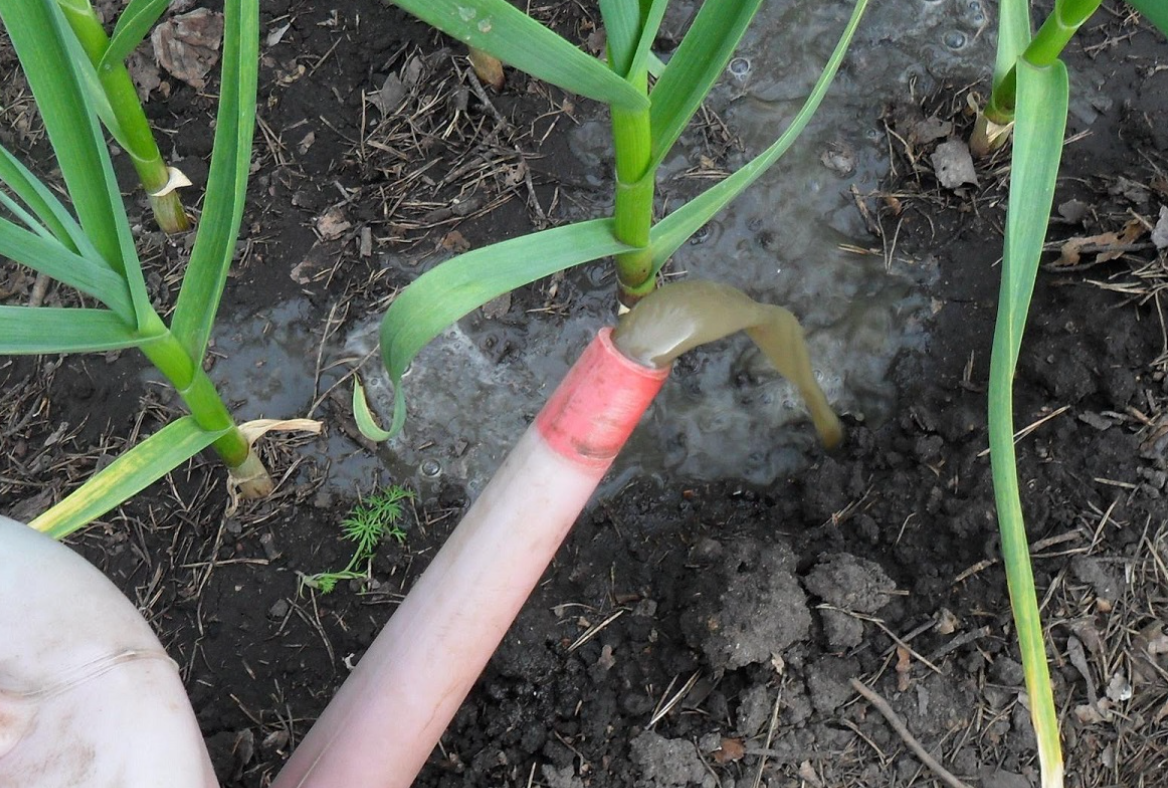
Garlic the size of a fist: agronomists shared an effective feeding scheme in April
For those who want to grow large garlic, plant nutrition is a key factor, and it is in April that the main measures should be taken.
During this period, garlic actively accumulates green mass, and it is then that the size of the head is formed. If you do not pay due attention now, it will be difficult to correct the situation later.
The feeding system is quite simple, but you should not ignore it if you expect a good result.
The first feeding should be carried out when the garlic has 3-4 leaves. It is at this moment that the plant needs nitrogen, since it is responsible for the formation of powerful leaves, which, in turn, affects the size of the head.
The most effective option is ammonium nitrate. It is dissolved in water and applied to the beds in a volume of approximately 2-3 liters per square meter. If the soil has already warmed up, you can also use urea, which acts softer, but no less effectively.
Mixtures for top dressing:
Ammonium nitrate: 20-30 g per 10 l of water (about 1.5-2 tbsp. l. without a hill); consumption: 2-3 l per 1 m².
Urea: 15-20 g per 10 l of water (about 1 tbsp. l.); consumption: also 2-3 l per 1 m².
After 10-14 days, a second top dressing is performed. Here, many make a mistake by continuing to inject nitrogen. As a result, garlic develops a lot of tops, but the head remains small.
For this stage, it is necessary to apply nitroammofoska – a complex fertilizer containing nitrogen, phosphorus and potassium. It provides the plant with balanced nutrition, which contributes to the growth of both leaves and the formation of a large head.
Nitroammophoska: 20-30 g per 10 l of water (1.5-2 tbsp. l.); consumption: 3-4 l per 1 m².
At the end of May, the situation may be different. The third top dressing should be carried out according to the condition of the plants. If the garlic looks healthy, with dark green leaves, nothing needs to be added. If it looks weak, it is worth connecting phosphorus and potassium, using superphosphate and potassium sulfate. The goal here is not to stimulate growth, but to help form a strong and large head.
Superphosphate: 30-40 g per 10 l of water; potassium sulfate: 15-20 g per 10 l of water; consumption: 4-5 l per 1 m².
There is one important nuance: top dressing should be done only on moist soil, best in the morning or evening, and strictly under the root. Watering the leaves is a bad idea. First, lightly moisten the bed with water, then apply fertilizer, and after absorption, gently loosen the soil.
It should also be noted that using fresh manure in the spring is not the best approach, as it can harm the plants.
In summary, the feeding scheme is quite simple: first apply nitrogen, after a few weeks – complex fertilizers, and then adjust according to the condition of the plants, focusing on phosphorus and potassium. No magic – just effort at the right time, and your garlic can become one that will delight your neighbors.
As a reminder, be careful when planting tomatoes and peppers to avoid common mistakes, and know how to prepare beds for carrots to get a big harvest.