
Unique phenomenon: planet orbits stellar remnants at 90-degree angle
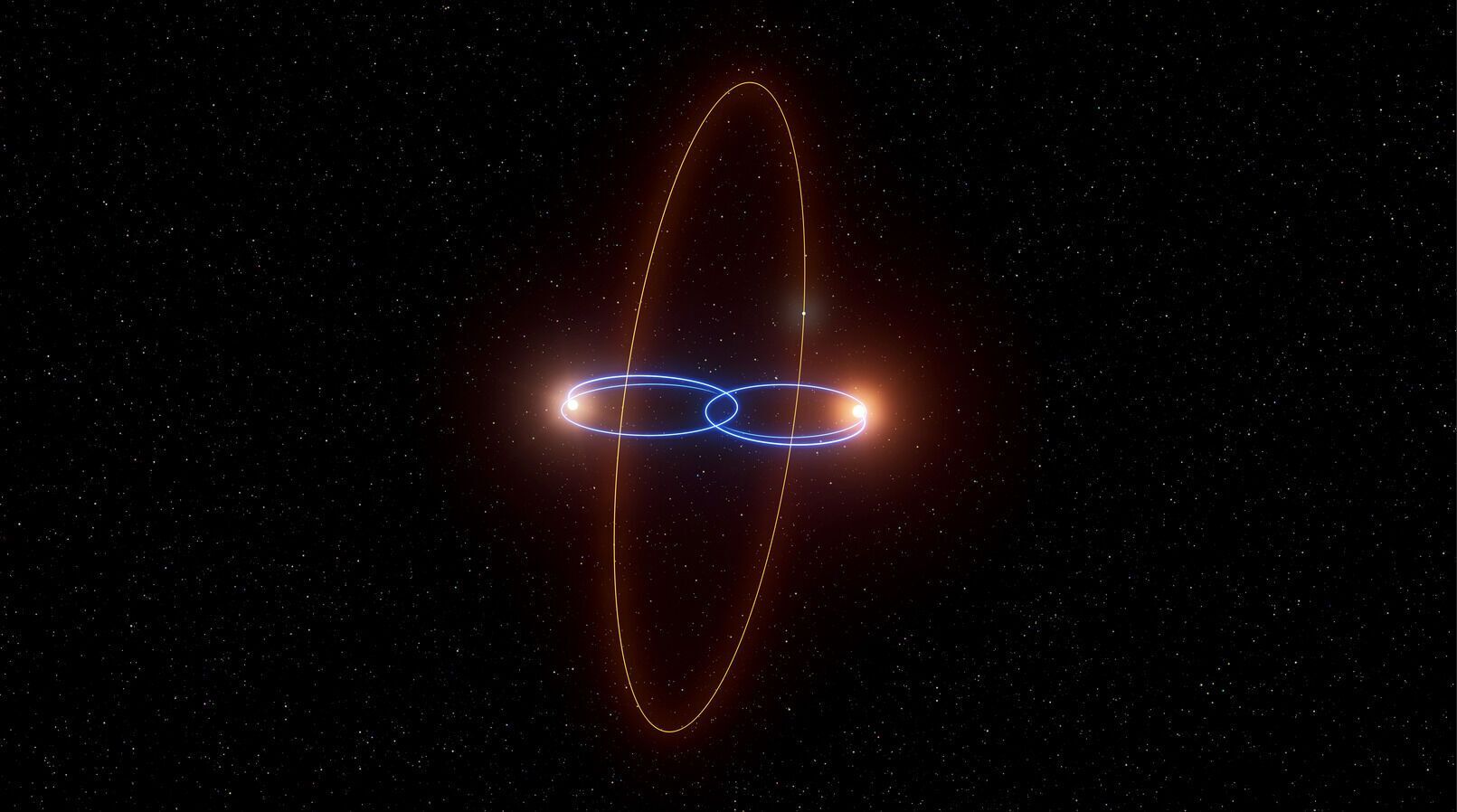
Astronomers have discovered a unique planetary system, designated 2M1510, using the Very Large Telescope in Chile. The system is striking in that the possible planet candidate orbits a pair of brown dwarfs in a polar orbit.
The newly discovered object, tentatively named 2M1510, has caught the attention of researchers due to its unusual orbit. The planet in this system orbits along a trajectory that passes over the poles of two brown dwarfs, which, although more massive than planets lack sufficient mass to become stars. These two dwarfs orbit each other, while a third dwarf is much further away and also orbits the pair.
Unlike traditional planets in the solar system, which orbit in the same plane, 2M1510 b, if confirmed, orbits perpendicular to the plane of the brown dwarfs, creating a polar orbit.
Planets that orbit two stars are called circumbinary, and they are scarce. However, the case of a planet orbiting at an angle of 90 degrees is unprecedented. The discovery was made possible by observations made with the Very Large Telescope, operated by the European Southern Observatory.
The 2M1510 system was discovered not through the traditional method of detecting planets when an object passes in front of a star but through the radial velocity method. This method is based on the change in the spectrum of light that occurs due to the gravitational influence of a planet on a star, causing it to wobble. In this case, changes in the orbit of brown dwarfs indicate the possible presence of a planet.
There are currently only 16 such circumbinary planets registered among the more than 5,800 discovered exoplanets. Most of them were found using the Kepler telescope, which has now completed its work. Scientists have long suspected that planets may rotate in polar orbits, as evidenced by the observation of debris disks at such angles. Now, this has received the first direct confirmation.
The study was carried out by an international team of scientists led by Thomas A. Baycroft, a graduate student at the University of Birmingham in the United Kingdom. The results of the study were published in April 2025 in the journal Science Advances, and on May 1, 2025, information about the system 2MASS J15104786-281874 (2M1510) was added to NASA’s Exoplanet Archive.