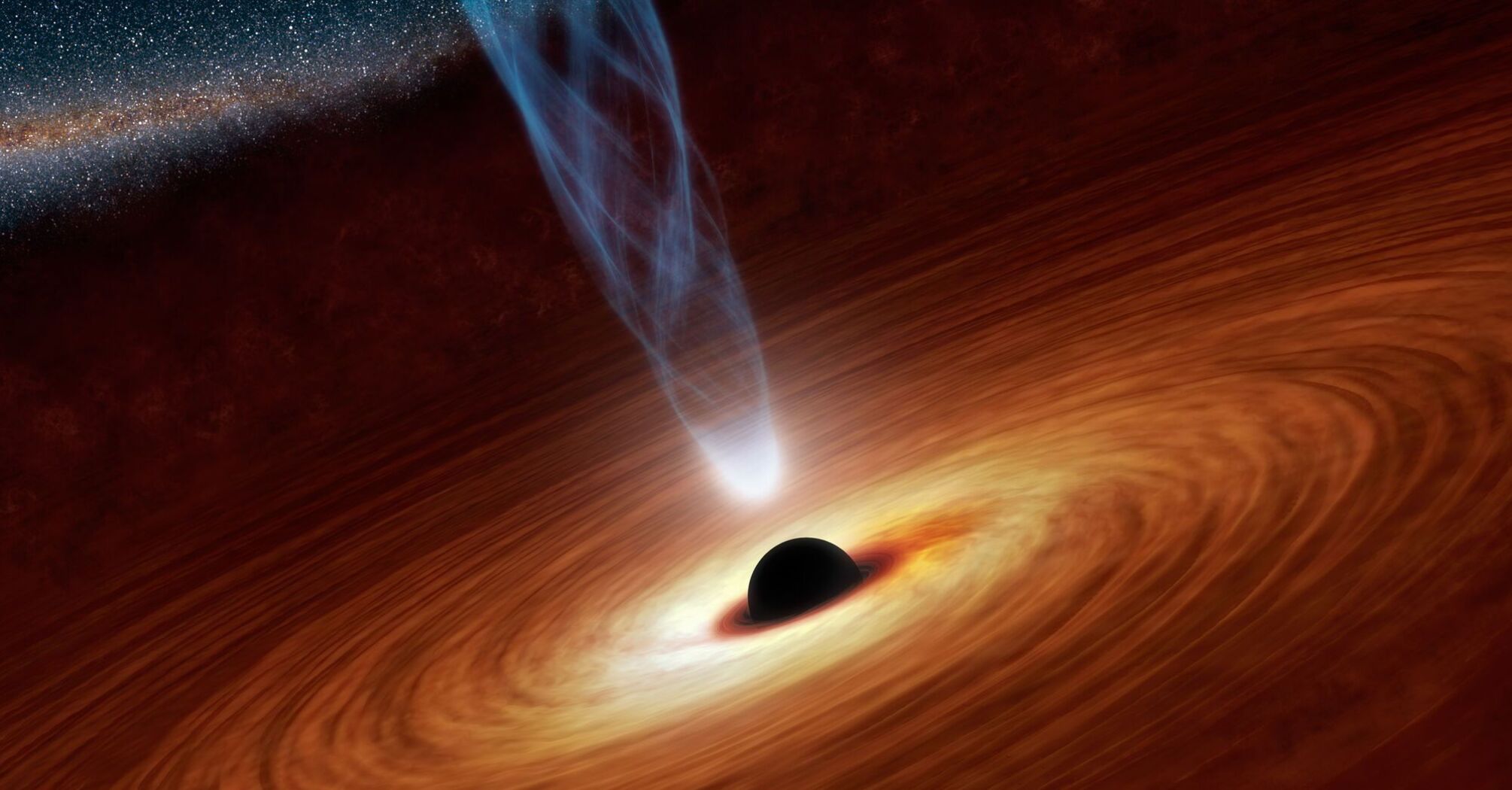
Black hole M87*: impressive rotation speed and matter absorption rate
The black hole M87*, located at the heart of the galaxy M87, has been the subject of new research. Scientists have found that its rotation is approaching maximum limits, and the rate of matter absorption is occurring much faster than previously thought.
This supermassive black hole, first recorded in 2019 through a historic image, continues to amaze astronomers with new research data. Recent observations have revealed that its rotation speed is 80% of the maximum possible rate, which is a significant approximation to the theoretical limit.
Researchers have found that the black hole’s inner accretion disk rotates at a speed equivalent to approximately 14% of the speed of light. This discovery was made possible by analyzing the light emitted by matter orbiting the black hole. Because matter moving toward the observer appears brighter, while matter moving away appears dimmer, astronomers were able to determine the speed of rotation accurately.
The study also revealed that the black hole is consuming matter at speeds of up to 23% of the speed of light—far faster than previously estimated. The amount of matter that M87* is consuming varies from 0.00004 to 0.4 solar masses each year.
The black hole in M87* remains a crucial object in astronomy, as its study provides new insights into the nature of gravity and the structure of spacetime. The results could also shed light on how supermassive black holes influence the evolution of galaxies and the processes that occur within such cosmic objects.
Recently, in Chile, at the base of the Very Large Telescope, an unusual planetary system, 2M1510, was discovered with a rare polar orbit of a candidate planet orbiting a pair of brown dwarfs.